
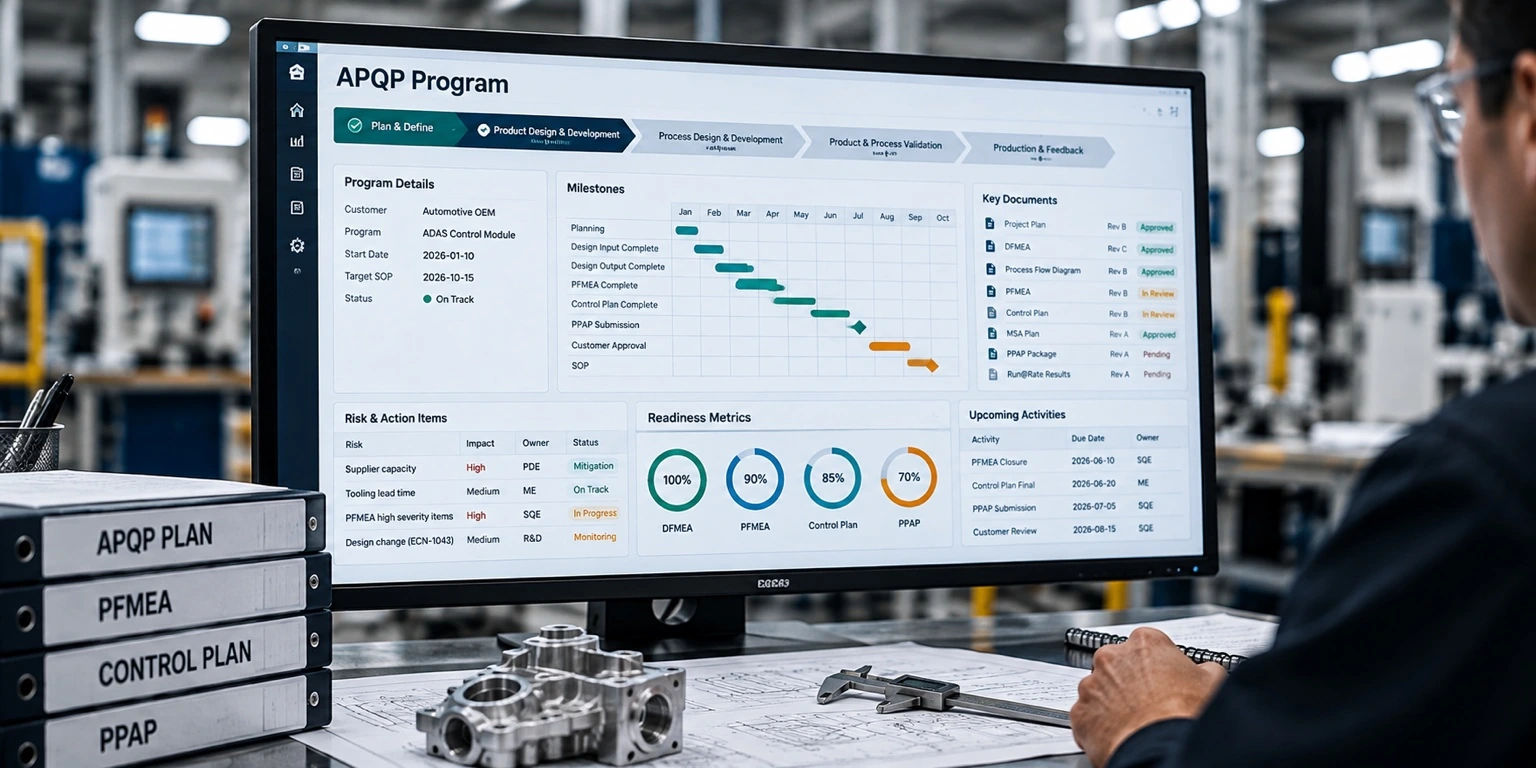
The operating question
Do product, process, supplier, quality and timing evidence tell one consistent readiness story?
A practical framework
- Translate program risk into deliverables, owners, timing and required evidence.
- Keep process flow, PFMEA, Control Plan and validation outputs aligned as knowledge changes.
- Use gates to expose and disposition risk before it transfers to launch.
What the technical work needs to resolve
The quality of APQP depends on interface control. Product changes affect process design; process changes affect risk and controls; supplier changes affect validation and submission evidence.
A red, yellow or green status is useful only when the criteria and underlying evidence are explicit. Readiness should not be inferred from document presence or percentage-complete reporting.
Scale the framework to what is riding on the decision. A narrow issue may need a short evidence review; a production or quality decision may need controlled requirements, representative trials, traceability and formal disposition. In either case, keep assumptions visible so later changes do not quietly invalidate the conclusion.
Common failure modes
- Managing an APQP checklist separately from program decisions.
- Updating one quality document without reconciling the others.
- Using due dates as substitutes for acceptance criteria.
- Carrying open high-risk items into launch without defined containment and authority.
These failure modes are tempting because they create visible activity quickly. The risk begins when activity is mistaken for progress. Close the work only when evidence shows that the requirement, process or decision now behaves as intended.
Build a deliverable matrix that names the evidence, accountable owner, reviewer, acceptance criteria and affected interfaces for every critical output.
To put the framework into practice, define the owner, controlled inputs, interfaces, expected output, exception path, acceptance criteria and verification record. That turns the insight into something usable in a design review, supplier discussion, production trial or management decision.